The Best Time for a La Fortuna Coffee Tour
Short answer. Any month. Every farm here runs year-round and none of them has a season, because cacao fruits all year and the coffee rows are picked as they ripen. February and March are driest, October is wettest, and November gives you dry weather and ripe cherries at the same time.
Every other coffee destination answers this question with a harvest month. La Fortuna cannot, and the reason is the most useful thing to understand about these farms before you book one.
Why is there no season here?
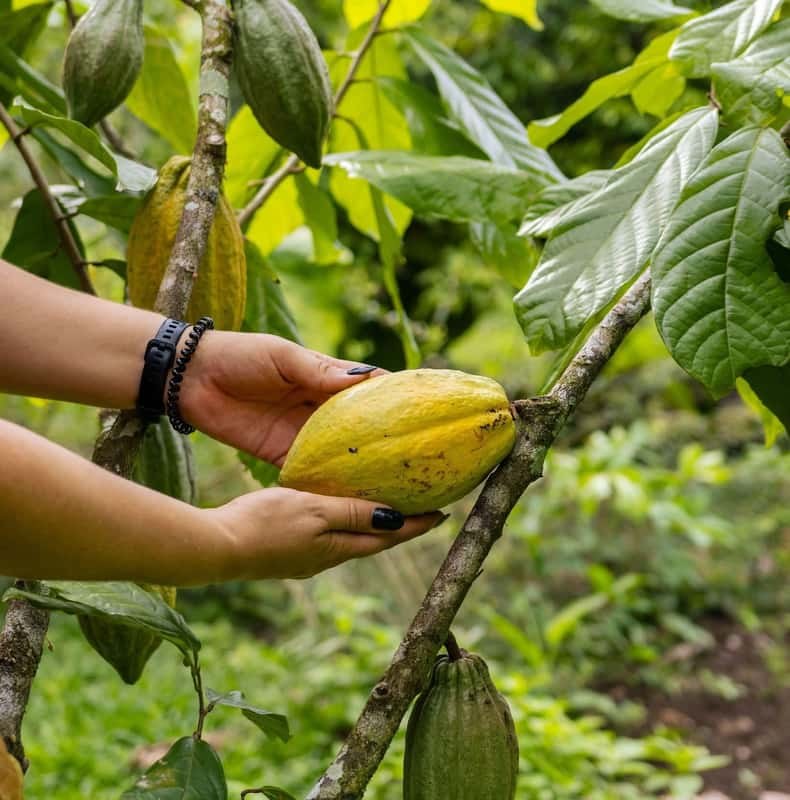
Two reasons, both geographic. La Fortuna sits at 253 metres, below the bottom of Costa Rica's altitude-based coffee grading scale, so these farms are not shipping lots to an exporter and are not picking to an exporter's calendar. And cacao — the crop this ground actually suits — flowers and fruits more or less continuously in a warm, wet lowland climate.
The result is that all of the listings run year-round and not one of them advertises a season. What decides your month is rainfall and your own timetable.
When is Costa Rica's coffee harvest?
Roughly November to March, peaking in November in the Alajuela and Heredia highlands and starting as early as July in Pérez Zeledón and Turrialba. Around 70,000 pickers work it, about 40,000 of them Costa Rican.
It is a genuinely impressive thing to see and it happens a long way from here, up in the recognised growing areas. On a La Fortuna demonstration row you will find ripe cherries in that window and green ones outside it, and the rest of the process runs identically either way — the harvest page has the month-by-month detail.
The two seasons, in millimetres
Rainfall from the La Fortuna climate record; every listing here runs year-round.
| Period | Rainfall | Volcano views | Crowds | Farm tours |
|---|---|---|---|---|
| December to February | Low | Best | Busiest | All running |
| March to April | Lowest, about 46 mm in March | Very good | Busy | All running |
| May to June | Rising | Mixed | Quieter | All running |
| July to August | High | Often clouded | Busy again | All running |
| September to October | Highest, about 331 mm in October | Poor | Quietest | All running |
| November | Falling | Improving | Moderate | All running |
Which month is best overall?
February, on the balance of everything. It has March's low rainfall with slightly fewer people, the volcano is out more often than not, and both morning and afternoon departures are reliable so the fixed one and three o'clock slots become useful.
March is the driest month on the record and the hottest half of the year is starting, which matters more on the open-air farms than on the covered one. January is the other strong candidate and is busier.
Which month is the best value?
September or October, if you can take the rain. They are the quietest weeks of the year on these farms, which means small groups and often a guide to yourselves — and a near-private farm tour is a different and better experience than a full one.
Flights and rooms are cheaper too. What you give up is the volcano, which spends most of those two months behind cloud.
The month for ripe cherries
November through March, and November most reliably, because that is when the national harvest peaks in the Alajuela highlands and the demonstration rows here follow the same broad curve. If picking your own cherries is the thing you want from the morning, come in that window and book the coffee-led farm rather than a cacao one.
Outside it the guide explains the ripening curve instead of demonstrating it, and everything from the pulper onwards is unchanged, because the beans on the drying bed were picked weeks ago.
The green season is not the problem it looks like. Rain here arrives in heavy afternoon bursts rather than all-day drizzle, so a morning booking usually runs in sunshine. Month by month, and what to bring.
Does the weather change what you taste?
Almost not at all, which surprises people. The coffee you drink was picked, pulped, fermented, dried and rested weeks before you arrived, and roasted in front of you on the day — and the roast is where a coffee's flavour is made. Cacao is even further out of the calendar, because fermentation and drying take weeks.
The only genuinely seasonal thing on the tasting table is the tropical fruit handed round as you walk on a couple of the farms, and that changes flavour rather than disappearing.
Which month for a family?
December to April, for the simple reason that wet farm ground and small children are a poor combination. If you are travelling in the green season instead, book the covered farm, where the trails are roofed and the paths are cement from one end to the other.
Group sizes are smaller in the quieter months as well, which suits a family with a wide age range: a guide who can slow down for a four-year-old and speed up past a station that is not landing. More on visiting with children.
What does the green season actually look like?
Not what northern visitors picture. It rains hard for an hour or two in the afternoon and then stops, the light afterwards is extraordinary, and the forest is at its loudest and greenest. Mornings are usually clear, which is why every farm's early departures are the ones to take between May and November.
The practical consequences are small: wet ground underfoot, a shell in the bag, and the volcano more often hidden than not. Nothing on the farm changes, because the yard and the tasting table are under cover on every one of them.
Should you book around the volcano instead?
If a clear view of Arenal is the reason you are here, yes — and that pushes you firmly into December to April. The cone spends much of the green season in cloud, and no amount of flexibility on the day fixes a month-long weather pattern.
Do that and the farms come along for free, because they run in every month anyway. It is the only fixture in a La Fortuna itinerary that never needs to be planned around, which is exactly why it is worth booking around everything else — the rest of the town is here.
Does the month change the group size?
More than the price does. December to April is the busy half and mornings fill, which on a farm capped at fifteen means fifteen. September and October are the quietest weeks of the year, and a booking that nobody else joins runs as a private tour at the group fare.
If a guide's undivided attention is worth more to you than a clear volcano, the wet months are the better booking and they are cheaper to travel in as well.
How far ahead should you book, month by month?
- Late December and early January: a week. It is the busiest fortnight of the year.
- February to April: three to five days.
- July and August: four to five days, because the northern summer holiday fills slots even though the weather does not.
- May, June, September to November: two to three days is plenty, and the day before often works.
Which month for a coffee drinker?
November to March, and for one reason only: it is the window in which you can pick a ripe cherry yourself rather than have the ripening curve described to you. Everything after the picking — pulping, fermenting, drying, roasting, grinding, brewing — runs identically in every month, because the beans on the bed were picked weeks before you arrived.
If that matters to you, book the coffee-led farm in that window and ask when you reserve whether the rows are carrying fruit. If it does not, come whenever suits and spend the difference on a second farm morning instead.
The answer in one line
There is no wrong month, which is unusual enough to be worth saying twice. Every farm here runs year-round, the process is identical in February and October, and the only thing the calendar changes is how wet you get walking between the trees and how often you see the top of the volcano.
Come whenever the rest of your trip says, book a morning slot if it is the green season, and take the covered farm if the forecast is heavy. There is no month in which these farms are closed, no month in which the process is not running, and no month in which the chocolate is worse. Every one of them is on coffee and chocolate tour in La Fortuna, listed with fares and hours on La Fortuna Coffee Tours, and the visiting page covers the practical side.
Frequently asked questions
When is the best time to do a La Fortuna coffee tour?
February, on balance: low rainfall, good volcano odds and slightly fewer people than January. March is drier still and hotter. Every farm runs in every month, so the choice is about weather rather than availability.
Is there a coffee harvest season in La Fortuna?
Not one that governs a visit. Costa Rica picks nationally between November and March, but at 253 metres these demonstration rows are picked as they ripen and cacao fruits through the year.
Will I see coffee being picked?
Between November and March there are usually enough ripe cherries to pick a handful yourself. Outside that window the trees carry green fruit and the guide explains the curve instead.
Is the green season worth avoiding?
Not for the farms. Rain arrives in afternoon bursts, morning tours usually run in sunshine, and one farm is roofed end to end. It is the volcano views that suffer, not the tour.
Which month is quietest?
September and October, which are also the wettest. Small groups and often a guide to yourselves, at the cost of a clouded volcano.
Tours that run in every month of the year
North Fields Cafe: Craft Specialty Coffee and Chocolate Tour
Hotel pickupTastingsMax 15
From $46 per person