La Fortuna Coffee Tours and the Weather
La Fortuna is one of the wettest corners of Costa Rica, and every farm tour here is outdoors. That sounds like a problem and mostly is not. The walking sections are short, the processing yard and the tasting table sit under a roof on every farm, one tour is covered end to end, and all of them refund in full up to 24 hours ahead.
Weather earns a page of its own because it is the only variable that decides your month. There is no harvest window to plan around here. The question of when to book coffee tours in La Fortuna comes down to millimetres of rain, and to how much you mind them.
The two seasons, in millimetres
The dry half runs roughly December to April. The green season runs May to November — Costa Rica's own word for the wet half, and a fair one, since this is when the country looks its best. The difference is not subtle. March averages about 46 mm of rain and October about 331 mm, seven times as much on the same fields.
What that does not mean is seven times the disruption. Green-season rain here arrives in heavy afternoon bursts rather than as all-day drizzle, so a morning tour in September often runs in sunshine and the sky opens after lunch. The tours that start at eight or ten are the ones to book between May and November, and one farm publishes exactly those times.
Monthly rainfall from the La Fortuna climate record; every listing captured on 2026-08-29 runs year-round.
| Period | Rainfall | What it feels like | Farm tours |
|---|---|---|---|
| January to February | Low | Warm, bright, the busiest weeks | All running |
| March | About 46 mm, the driest | Hot and dry | All running |
| April | Rising | Hottest of the year | All running |
| May to August | High, July a peak | Humid, afternoon downpours | All running |
| September to October | Highest, October about 331 mm | Wet most days | All running |
| November to December | Falling | Drying out, greener than ever | All running |
Month by month, and what to book
Twelve short answers, because the useful version of this question is never "when is the dry season" but "I am coming in July, is that a problem". It is not.
January
Dry, warm and one of the two clearest months for the volcano. Everything runs, the open-air farms are at their most comfortable, and this is the first of the weeks worth booking a few days ahead rather than the night before.
February
The same weather as January with slightly fewer people, which makes it the best all-round month here if the rest of your trip is flexible. Morning and afternoon tours are equally reliable, so the fixed one, three and later departures come into their own.
March
The driest month on the record at around 46 mm, and the hottest half of the year is starting. Take a hat and more water than you think, because the walk through the planting is the exposed part on every farm except the covered one.
April
Hot, and the rain begins to build towards the end of the month. Still comfortably a dry-season booking, and a good time for the longer three-hour combinations, since a wildlife trail is far better in dry footing than in wet.
May
The green season opens. Afternoons turn showery while mornings usually stay clear, so shift a booking earlier in the day and carry a light shell. The forest around the farms greens up dramatically within a fortnight of the first proper rain.
June
Wet and warm, with a short drier spell some years around the middle of the month. The covered-trail farm starts to look like the obvious choice rather than a hedge, and the cacao side of every tour is entirely unaffected.
July
One of the two wettest months of the year. It is also one of the busiest, because it is the northern summer holiday, so book earlier than the weather would suggest. Mornings are the reliable slot and every farm still runs.
August
Wet, humid and green, with the same morning-good, afternoon-heavy pattern. Bring a dry bag for a phone and shoes you are happy to get muddy. Treat the roofed farm as the safe booking if you only have one free day.
September
The Caribbean slope does not get the dry September that Costa Rica's Pacific coast does, so expect rain most days. What it buys you is the quietest farms of the year, and a decent chance of having a guide to yourself.
October
The wettest month on the record, around 331 mm. Nothing closes and nothing changes inside the processing yard. The volcano does spend most of it behind cloud, so plan the farm morning and treat a clear Arenal view as a bonus.
November
The rain drops away through the month and the landscape is at its greenest. It is also when the national coffee harvest peaks in the Alajuela highlands. That makes it the easiest month to find ripe red cherries on the demonstration rows here.
December
Dry weather returns and the Christmas fortnight is the busiest booking window of the year. Give a booking a week's notice from about the twentieth, and take the earlier departures if you want the volcano in the photographs.
What rain actually does to a farm morning
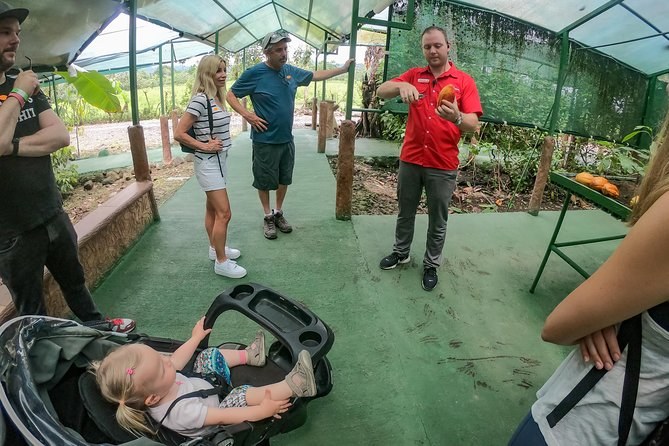
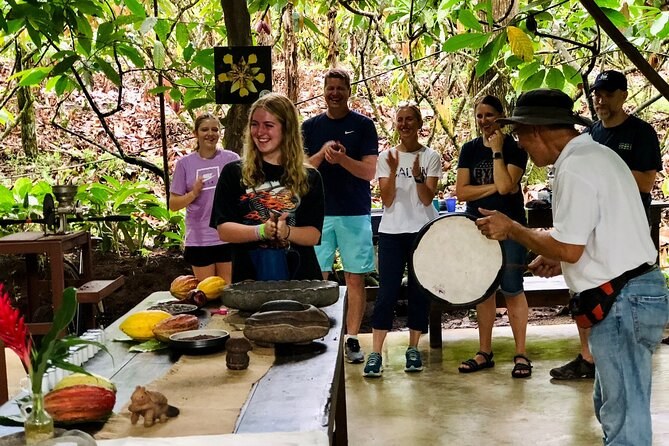
Less than you think. The walking sections run twenty to forty minutes. The two parts that matter most, the processing yard and the tasting table, are under cover on every farm here, because the open-sided rancho is the building this region is organised around. A light shell handles the rest.
What rain genuinely changes is the view. Arenal spends much of the green season in cloud, so the dry months matter far more for the volcano than for the farms. The rest of a La Fortuna day is where the weather really bites. The farm morning is the part you can book with confidence in any month.
The covered option
One farm answers the question outright. Its trails are covered and its paths are cement from one end to the other, and that is its headline feature rather than a footnote. The same design is why wheelchairs and strollers have no trouble on it. The wet-weather choice and the accessible choice turn out to be the same booking.
If the forecast is bad, book this one. A roofed trail turns a wet morning from a compromise into the obvious plan, and it costs the same as the equivalent open-air tour. The two-in-one coffee and chocolate tours include it.
What to bring, by season
The list barely changes across the year, because a rainforest is a rainforest in March as well as in October. What changes is how much of it you actually use.
- December to April: sun hat, repellent, water. Rain gear still worth carrying — this is a rainforest, not a desert.
- May to August: a light rain shell and closed shoes with grip. Two listings ban sandals and open-toed shoes, and wet farm ground is why.
- September to November: everything above, plus a dry bag for a phone and a spare shirt. One farm supplies ponchos.
- All year: insect repellent, which four of these listings name in their own what-to-bring block.
Cancellations, lightning and refunds
Rain does not stop these tours. Lightning does, and the farms treat it as a safety call rather than a judgement call. One traveller account describes a wildlife walk cut short mid-storm, with the booking refunded in full afterwards.
Every listing here cancels free up to 24 hours before the start time. A forecast you do not like is a reason to move a booking rather than to skip one. Several farms will also reschedule for weather and refund in full if the new date does not suit. Which month suits the rest of your trip is on the harvest page, and the tours are on La Fortuna Coffee Tours.
Tours that run whatever the sky is doing