Facts About La Fortuna Coffee Farms
Short answer. La Fortuna sits below the bottom of Costa Rica's coffee grading scale, which is why cacao rules here. One farm runs 1,600 cacao trees and makes 150 pounds a week. Another builds its tour on native stingless bees. And for thirty years it was illegal to plant robusta anywhere in the country.
Coffee facts usually travel badly — they are either trivia or marketing. These came out of the listings themselves and out of Costa Rica's own agricultural record, and each one changes something about how you would choose a farm morning.
1. The altitude puts these farms off the scale
Costa Rica grades green coffee by where it grew. Strictly Hard Bean comes from above about 1,200 metres, Good Hard Bean from 1,000, Medium Hard Bean from below. La Fortuna is at 253 metres. Every bag of coffee you have ever bought marked SHB came from more than four times that height.
It is the single most useful thing to know before you book, and it is not a criticism. It is why these farms teach rather than export, and why the tour is hands-on.
2. None of the eight famous regions is anywhere near here
Costa Rica recognises eight coffee-growing regions: the Central Valley, the West Valley, Tarrazú, Tres Ríos, Orosi, Turrialba, Brunca and Guanacaste. The San Carlos lowlands are not among them. If a highland estate is what you pictured, that is a separate trip — and a La Fortuna farm morning is a better introduction to the process than any of them.
3. Planting robusta was illegal for thirty years
In 1989 Costa Rica banned planting robusta outright, to force the country onto arabica and protect its reputation. The ban held until 2018, when it was lifted for warmer regions to give farmers a hardier option as the climate shifted. The crop is still overwhelmingly arabica, so what you drink on these farms is arabica too.
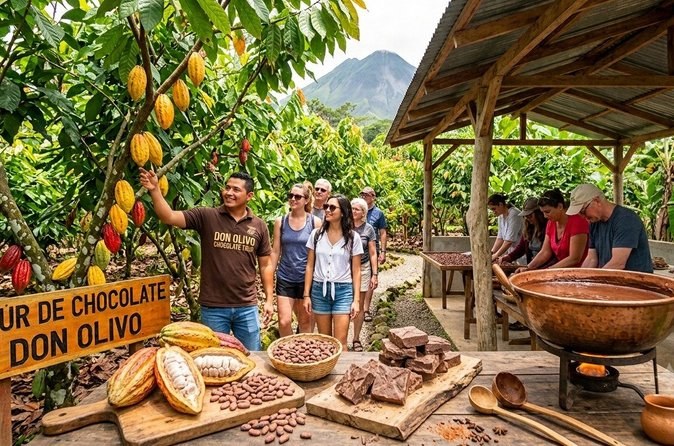
4. One farm runs 1,600 cacao trees and produces 150 pounds a week
Those are the numbers Don Olivo publishes about itself, on a plantation started by the guide's own grandfather. It is also the only farm here with a fixed daily timetable — eight, ten, one and three — which makes it the easiest thing in town to slot around a waterfall.
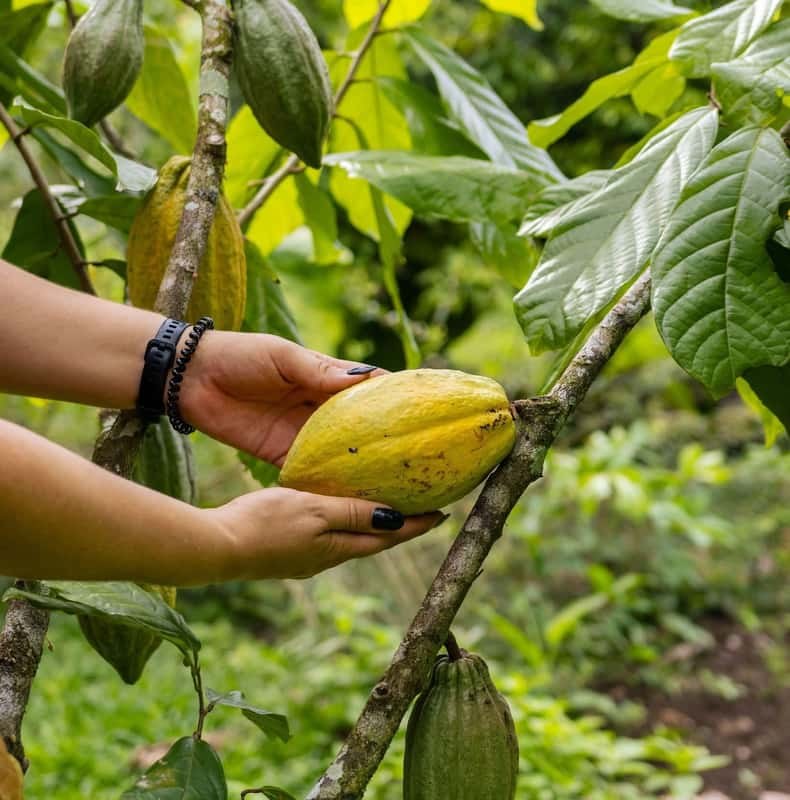
5. Cacao flowers grow out of the trunk
Not off the branches, out of the bark of the trunk and the main limbs. The botanical word is cauliflory, and cacao is the most familiar plant that does it. Nobody quite believes it until they are standing in front of one.
6. One farm's whole tour is built on bees that cannot sting
Costa Rica has native stingless bees, meliponas, kept here long before European honeybees arrived. Their honey is thinner and sharper than the honey you know, and different species make noticeably different things. One organic farm opens its tour at the hives and tastes the varieties side by side before it goes anywhere near cacao.
7. The wettest month gets seven times the rain of the driest
March averages about 46 mm. October averages about 331 mm. Every farm tour runs in both, because the yard and the tasting table are under cover everywhere and one farm's trails are roofed from end to end.
Figures from the Costa Rican coffee record, the local climate record and the farms' own listings.
| Fact | The number | Why it matters to you |
|---|---|---|
| La Fortuna's elevation | 253 m | Below the coffee grading scale |
| Arenal Volcano | 1,657 m | The cone over every farm here |
| Costa Rica's coffee regions | Eight | None of them is this one |
| Robusta ban | 1989 to 2018 | What you drink is arabica |
| Driest month | March, about 46 mm | The clearest volcano views |
| Wettest month | October, about 331 mm | Book the roofed farm |
| Arenal's last eruptive period | 1968 to 2010 | The lava you walk on |
8. Cacao here has no season, and coffee barely has one
Costa Rica's national coffee harvest runs November to March and peaks in November in the Alajuela highlands, with around 70,000 pickers working it. None of that governs a La Fortuna farm, because a demonstration row is picked when it is ripe rather than to an exporter's calendar. Cacao trees, meanwhile, flower and fruit more or less continuously in this climate.
The practical result is that every farm here runs year-round and not one of them advertises a closed season. Whatever month you arrive, the fermentation boxes and the drying beds are in use.
9. The volcano stopped erupting in 2010, after forty-two years
Arenal Volcano erupted violently on 29 July 1968 after centuries of quiet, burying fifteen square kilometres and destroying three villages. The eruptive period that began that day ran until December 2010. It is still an active volcano in its longest quiet stretch since, and the lava field the park trails cross is what those decades left behind.
10. Sloths keep turning up on coffee tours
They are not on the itinerary and they appear anyway. A working smallholding with shade trees and flowering cacao is good sloth habitat, and travellers report seeing them mid-tour on six of the farms in this district, alongside toucans, coatis, armadillos and red-eyed tree frogs. Two listings make wildlife an explicit half of the morning with a guided trail and spotting scopes, but on the rest it is simply what happens when you walk slowly through a Costa Rican farm and look up.
11. Nobody feeds you
Not one of the La Fortuna farm tours includes lunch or dinner. Several finish with a snack, one cooks it over an open flame, and one farm has a restaurant on the property — but the fare covers tastings, not a meal. It is the commonest hidden cost here and it is one line on every listing.
- Admission is inside the fare on every tour.
- Two exclude gratuities in writing.
- Three exclude transport to the farm.
- All of them cancel free up to 24 hours ahead.
12. The paths are better than the farmland suggests
Four of these farms publish wheelchair and stroller access, with cement paths throughout and no steps on the route. One goes further and roofs the whole trail. One offers infant seats, and one states plainly that its ground is not suitable for wheelchairs. For working farmland on a rainforest slope that is an unusually good record, and it is the reason these tours turn up so often on family itineraries.
Turn this into a booking. If the altitude fact appeals to you, book cacao-first. If it disappoints you, book the one farm here that is coffee and nothing else. The five farms, compared.
None of this is why people come to La Fortuna — the volcano is. But it is why the farm morning turns out to be the thing they talk about afterwards, and it is worth knowing before you choose between None.
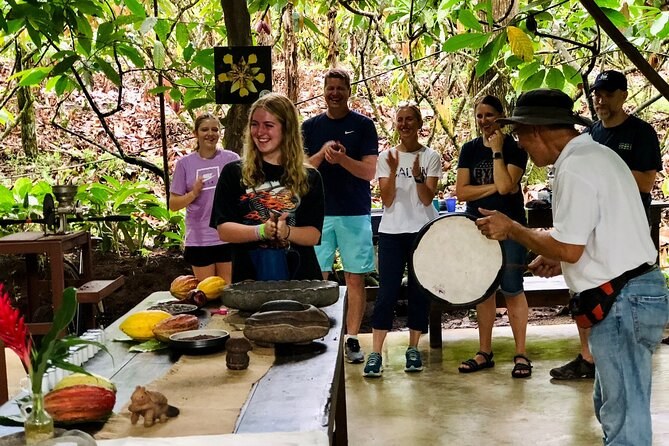
The pattern behind all twelve is the same one. This is not a coffee region and it has never pretended to be, so the farms here compete on access rather than on altitude: a whole process in one field, a family who will answer anything, and a price that starts below what a highland estate charges for a tasting alone. Read the listings with that in mind and the choices sort themselves out quickly.
Each of these farms is the source of one of the numbers on this list. They are all bookable through La Fortuna Coffee Tours.