North Fields Cafe: Craft Specialty Coffee and Chocolate Tour
Hotel pickupTastingsMax 15
From $46 per person
Three things trip people up before they book, and all three are fixable in the five minutes it takes to read this. These are smallholdings, not estates. You do not need a car. And on most of them the coffee is not the main event.
La Fortuna sits at 253 metres. Costa Rica grades its coffee by altitude — Strictly Hard Bean above about 1,200 metres, Good Hard Bean from 1,000, Medium Hard Bean below that — so these farms sit under the bottom of the scale. None of the eight regions the country is famous for is anywhere near here.
What that buys you is better than it sounds. On a highland estate the picking, the milling and the roasting happen in three different places and you see one of them. On a smallholding at 253 metres the whole chain fits inside one fence, so you walk from the tree to the cup in about ninety minutes. If you want the country's celebrated coffee regions, drive south. If you want to understand how coffee is actually made, book None.
Every farm here is within a few kilometres of the same small town. A couple of the listings put transport inside the fare: one collects from any hotel within about ten minutes of La Fortuna, the other from downtown and the streets around it. For the rest, a taxi across town costs a few dollars and takes ten minutes.
The one exception is the fourteen-hour trip that starts in San José, four hours south, and treats La Fortuna as a lunch stop. That is a different holiday, and it is priced like one. The visiting page has the meeting points farm by farm.
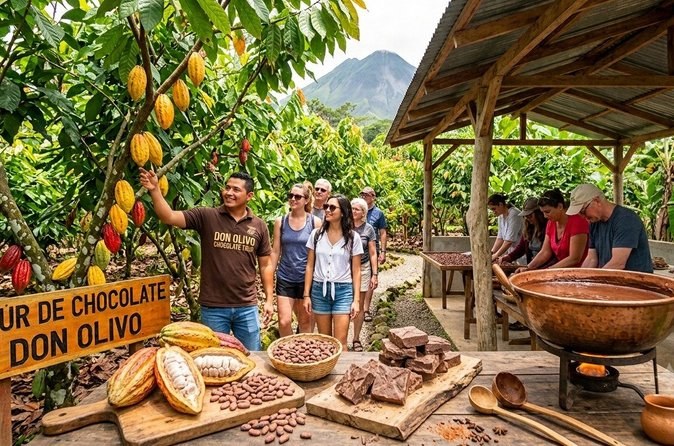
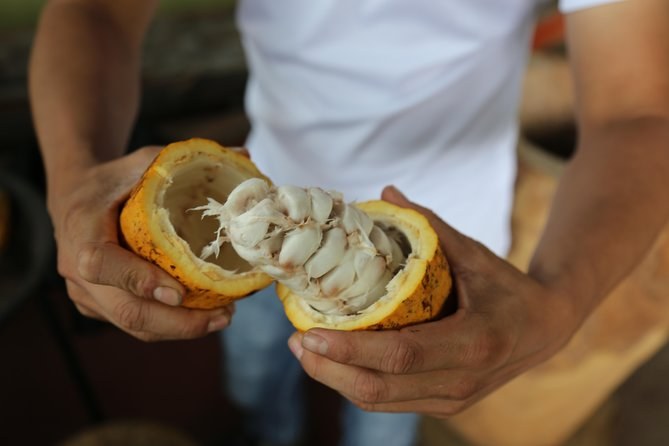
Cacao thrives in warm, wet lowland on the Caribbean slope in a way coffee does not, and the listings know it. All but one of the tours here put cacao on the table, and two of them are cacao and nothing else. If you arrive expecting a coffee tour with a chocolate footnote, you have the emphasis backwards.
That is not a reason to skip the coffee. It is a reason to pick the tour that leads with whichever crop you actually came for — what you taste, crop by crop sets out both.
The spread runs from $30 to $165, and it is not about how good the coffee is. It is about transport, hours on the farm, and how many crops the tour covers.
| What you pay | What that buys | What to check |
|---|---|---|
| $30 to $40 | 90 minutes to 2 hours on one farm, cacao-led | You make your own way there |
| $46 to $62 | 2 to 2.5 hours, coffee and cacao together | Only one of them includes pickup |
| $100 | 3 hours: a guided wildlife trail plus a farm | Lunch and transport sit outside the fare |
| $165 | A 14-hour day out of San José | Coffee is one stop of six |
Timing here is decided by weather, not by harvest. Costa Rica picks between November and March, but at this altitude the demonstration rows are picked as they ripen, and cacao fruits through the year, so every tour runs in every month.
What varies is rainfall: about 46 mm in March and about 331 mm in October. Farm tours run in both, because the processing yard and the tasting table are under cover everywhere and one farm's trails are roofed end to end. Book a morning slot between May and November and you will usually beat the afternoon downpour. There is more on that in what rain does to a farm tour and in the harvest season page.
Two to five days ahead covers most of the year, and a week over Christmas and through the spring break. Most listings confirm instantly and one takes up to 48 hours, which matters if you are booking for tomorrow. One farm needs two travellers confirmed before it will run, and refunds in full if it does not reach that.
Everything here cancels free up to 24 hours before the start time. In a town this changeable that is the single most useful clause in the booking, and it is the reason booking ahead costs you nothing in flexibility.
Closed shoes, light clothes and something for rain, in every month. Two listings ban sandals and open-toed shoes outright. Insect repellent and a hat appear on four of the what-to-bring lists, and a little cash is worth having because every farm sells its own roast, bars or honey at the end.
Access is good on most of them: four publish wheelchair and stroller access with cement paths throughout, one offers infant seats, and one states plainly that its trail is not suitable for wheelchairs. Check the tour you want rather than assuming from the others.
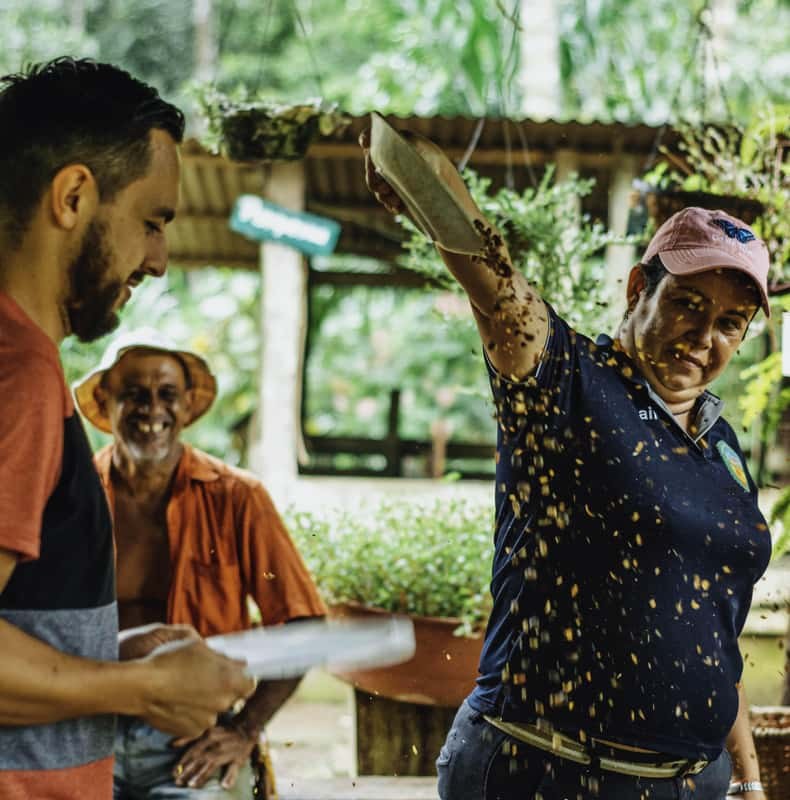
If this is your only farm morning, take the two-in-one: an hour on coffee and an hour on cacao, so you see both chains and can decide afterwards which one you would go back for. If the budget is the constraint, the cacao-only farms start at $30 and give you ninety minutes to two hours of the most theatrical part of the process. If you came for coffee specifically, one farm here leaves the chocolate out entirely and puts you to work picking, roasting and grinding your own.
Group size is small everywhere. Four farms cap a tour at fifteen travellers and one at thirty, and the rest publish no number, which in practice means a handful of people and sometimes just you. That changes the morning more than the price does, because a small group turns the tour into a conversation with somebody who farms for a living.
Two hours is short, which makes the farm the flexible half of a La Fortuna day. One farm publishes fixed departures at eight, ten, one and three precisely so it can be slotted around something else. Pair a morning tour with the waterfall, or an afternoon tour with the hot springs, and neither one gets rushed — what else is in town sets out the combinations.
If you have a wet day and a dry day in the forecast, spend the wet one on a farm. The covered trails and the roofed ranchos are the most rain-proof thing here, and the volcano needs the clear day far more than the cacao does.
Pick the one whose emphasis matches yours and book it a few days out. Everything above is on La Fortuna Coffee Tours.
From $46 per person